
Grammar ♥︎ Practice auf Deutsch: 3 Twists That Trip Up German Learners (And How to Overcome Them Easily)

Before I dive deeper into German grammar for this week's useful blog post, I want to take a minute to say "I know!" to all of you who think that German is a hard language to learn. Today's article is about to prove that you guys are not entirely wrong. Yes, the German language has some Tücken (twists).
But read on to discover how to get over each of these twists without ever worrying about them again.
Just like I did in our French Grammar Practice, I've selected 2 topics for German beginners and 1 twist for advanced learners. So there's something here for everyone.
Twist #1: sie is not Sie is not sie
The little words that can take the place of a noun or a name in language are called pronouns. They are placeholders that make it easier for us to communicate - just imagine how that previous sentence would work if I didn't have the words "they" and "us" for example! When you learn a foreign language, you start picking up its pronouns very early.
In German, this is particularly true as the verb doesn't do all that much by itself. The way pronouns are used is pretty similar to English, but here's the sting: 3 German pronouns look similar when they are not similar at all. I'm talking about the word sie, which you'll spot 3 times in the German pronoun table.
Many German learners are aware that Sie is the polite "you" in the German language, addressing a person from a point of distance or respect. It's corresponding to the French vous in this way. But if you think that's all you need to understand sie, it is time to take a look at the full verb table:

Sie pops up three times, but each time this word stands for a different person. There is more to it than just the polite "you".
There are three different kinds of sie
- It stands for the female 3rd person singular pronoun - that's "she" in English
Examples:
Sie heißt Melanie. - Her name is Melanie.
Das ist meine Schwester. Sie kann auch Spanisch. - This is my sister. She speaks Spanish too.
- It stands for the 3rd person plural pronoun - that's "they" in English
Examples:
Sie kommen aus Deutschland. - They are from Germany.
Das sind meine Geschwister. Sie können auch Spanisch. - Those are my siblings. They speak Spanish too.
- It stands for the polite "you" (grammatically that's also the 3rd person plural, kinda like addressing a royal "we")
Sie kommen aus Deutschland, Frau Krämer. - You are from Germany, Ms Krämer.
Wie heißen Sie? - What is your name?
How To Know The Difference
The first distinction is so easy to spot that I wouldn't even call it a "language hack". When you see Sie and the first letter is a capital letter, it's the polite you. Make sure you use it this way in your writing too.
If you're in a conversation (and you can't hear the capital letter), check out what the verb is doing.
When the verb ends in -t, you're looking at a "she".
When the verb ends in -en, it's most likely "they" or "you"...and then you have to figure out what the sentence is about and take other clues.
Twist #2: Prefixes are Everything
If you're going to learn one thing about German at an early stage, it's that the little things make all the difference. For example, take the concept of the separable verb. At the heart of it, you've got a verb like machen (to make, to do) or kommen (to come). Add a little prefix (usually 2-4 letters) to the verb, and suddenly you've twisted the meaning.
The good news here is that learning prefixes pays off a billion times over, as you'll be able to add them to pretty much any verb going to make yourself understood in spoken German. Prefixes split off when a verb is used in the sentence, so make sure you look out for them at the end of the sentence. So in other words, the final word in a sentence is very important in German. Sometimes it can twist the whole meaning.
Check out the following video from my German Grammar video Course for a detailed explanation.
Here are a few example sentences:
Wir kommen am Freitag. - We're coming on Friday.
Wir kommen am Freitag an. - We're arriving on Friday.
Ich komme heute. Er kommt am Freitag nach. - I'm coming today. He'll follow on Friday.
Wir fahren nach Berlin. Kommst du mit? - We're going to Berlin. Are you coming?
Test Yourself
How many words can you spot that carry the prefix auf? When you think of it's generic meaning "up", how many meanings can you guess from the following list?
- aufmachen
- aufgehen
- aufstehen
- auflegen
Let me know what your guesses are in the comments.
Twist 3: For Advanced Learners, werden becomes complex
The dictionary meaning of the German verb werden is "to become", plain and simple.
But watch out for two other ways that the verb is used. It teams up with another verb to build two advanced structures.
When werden works with another verb, the sentence structure is always:
Subject + werden + (any adverbs) + (any object) + the other verb
The other verb is what's really happening. If it stands in the infinitiv (that means it's not changed at all from how you find it in the dictionary), the sentence is in the future tense. For example, Ich werde etwas essen means "I will eat something". If it stands in the participle (this is that past tense form with ge-), then you're looking at the passive voice! For example, Etwas wird gegessen is not future tense at all
Examples:
Ich werde nach Berlin fahren. - I will drive to Berlin.
Ich werde nach Berlin gefahren. - I'm being driven to Berlin.
Ich werde den Käse kaufen. - I will buy the cheese.
Der Käse wird gekauft. - The cheese is being bought.
Der Käse wird gekauft werden - (combining future and passiv) The cheese will be bought.
So whenever your form of werden pops up, pay attention and make sure that you don't end up confusing future and passive. They're pretty different.
How to Escape The Werden Trap
One easy tip to speak German without the pains of werden is to avoid using the future tense altogether. That's what native speakers do all the time, simply using the present tense together with words like morgen (tomorrow) or gleich (in a minute). It's so simple, it's practically Chinese grammar! (Someone once told me Chinese doesn't have conjugation. I was like "whoah"!)
Where To Look For More German Grammar Explanations
If you're studying German grammar in your first year, you will find answers to every grammar question in my video course Easy German Grammar for Beginners. It contains dozens of simple videos, quizzes and workbooks to help you become a confident speaker.

Why High Achievers Struggle Most With Language Learning
I work with so many wonderful people who are determined to learn another language, and they're ready to work hard and put in the effort. Many language learners are high achievers, and they get so much right when it comes to commitment.

If you're a little bit like that and you've dropped off your language project, I want you to know that it's not you. After more than a decade of language coaching, I've observed that my high achieving clients can slip into some damaging mistakes and end up losing most of their progress.
You might already be guessing that I am talking about excess ambition here. To be safe from this kinda self-sabotage, let's see where it tends to creep in first.
The Real Problem: Your Expectations
The biggest mistake I see, across every kind of learner, is setting targets that were never fair to begin with. Not too little ambition. Too much, too fast, with no room to breathe.
The classic culprit: deciding to learn 50 new words a day. Or even 20. Approach the task at a realistic pace and look for materials that suit your level. The best level is one where you understand what's happening without having to work too hard.
Here’s how I explain the problem in my course Your Solid Vocab Memory:
"How many words?"
Some people like to have a specific number of words to aim for. When creating your routine, consider any numbers-based goal carefully and break it down into daily activities. But remember that regular reviews are what will anchor any words in your long-term memory. Cramming 1000 words in 10 days might be possible if you have an intensive project on your hands...but most learners forget those words very quickly.
Aim for a realistic level. In numbers, A1 level is usually considered to contain 1500-2000 words. But you can communicate with much less.
Fluency in speaking is about mindset and attitude. Confident and creative language learners have full conversations with way less than 5000 words.
Aiming for Fluency on a Deadline
The same thing happens with timelines. You do not have to become fluent in a very short period of time. Learning doesn't have to be a sprint. But plenty of learners set an ambitious deadline, miss it, and quietly decide they're just not a language person.
They are actually fine and talented, but sometimes life gets in the way or you just cannot control how fast your brain remembers things.
More about memorizing and how it works here
What Unrealistic Standards Actually Do
Impossible targets don't motivate you. They hand you an excuse to quit.
When something doesn't instantly click, and plenty of things won't, the distance between where you are and where you expected to be starts to feel like proof of something. That you're not cut out for this, everyone else finds it easier, and you probably left it too late.
None of that is true. But the target you set made it feel true.
What Actually Helps
Get honest about your real goal. Not the glossy version. If you want to muddle through a holiday conversation, you don't need to sound like a native speaker. If you want to connect with someone you love, showing up and trying counts for more than perfect grammar ever will.
And then bring in something the language learning world chronically undersells: self-compassion. The learners who go the distance aren't the ones who flagellated themselves into fluency. They're the ones who were decent enough to themselves to keep going when it got hard and a little boring and slow
How to Start Learning a Language (And Actually Stick With It)
Good news first: Starting is one of the hardest parts of learning a language! And starting isn’t that hard with this guide, so you’re already set up for good progress.
It’s not easy to feel confident that you’re starting “right”. There are so many different approaches out there, and the sheer number of options can stop you before you've even begun.
Here's what I actually recommend for beginners in language learning:
Start With Your Goal (But Not The Way You Think)
Early on in your learning progress, I recommend thinking about your goal. This does not have to be your big life goal for learning a language, but it helps you clarify what you really want out of it.
Some people want to speak to loved ones. Others want to enhance their career opportunities. Those are people who are probably going to be studying for years because they want to become fluent. Some people just want to have a chat on holiday, or they just want to understand more of what people are saying. Those people will practice different things.
And sometimes it helps to remember you do not have to have a goal. Sometimes it is simply, “I’m curious.” I LOVE ❤️ intellectual curiosity as a reason to learn a language. A lot of the languages I've learned started with nothing more than curiosity about a pronunciation, a greeting, a writing system. A few of them stuck, and I'm now conversational (for example, I fell in love with Welsh). With others, it didn't happen but I still know the basics. You are never wasting your time.
In my Language Habit System™, I recommend recording your Vision Goal. Record it at the start, and then get a little more practical.
Try Everything
Once you know your direction, explore properly. Don't stop at just downloading Duolingo and playing with it.
Go to your library. Have a look at textbooks. Download the apps. Get yourself on YouTube. Change a few parts of your social media feed and get your algorithm showing you things in that language. Very soon you'll be picking up little bits here and there.
Then it's about putting it all together, and that's where a group class can be great, or a tutor for the first three to six months, especially if you're new to language learning.
Follow what is fun. Follow what is exciting. That is how you stay motivated, and it helps you remember what you are learning for.
Think About All Four Skills
When you're planning how to spend your learning time, think about how you're going to get some listening, speaking, reading, and writing — all of them. Each skill informs the next. Writing, for example, can genuinely improve your speaking and listening once you understand the pronunciation rules of a language. They work together.
Grab my book about the four core skills 📘
Don't Overlook AI
I want to make a particular case for involving AI in your language learning, because I've been exploring and experimenting with it seriously, and I think it has the potential to be much more effective at teaching natural language — or letting you practise natural language — than apps alone.
It fulfils a slightly different purpose. Apps have their place. Tutors have their place. AI has its own place too. But that place is a genuinely valuable one, and it's worth exploring early.
The Most Important Thing
Language learning is a beautiful and enriching lifelong process if you let it. Allow yourself to enjoy it, even when you're not the best yet.
You don't have to become fluent on a tight deadline. You don't have to master fifty words a day. You just have to keep going, follow what interests you, and trust that every bit of it counts.

Listening Masterclass: How to Understand Native Speakers in Another Language
Struggling with listening? Discover realistic tips, challenge prompts, and the best tools for improving your listening skills as a self-guided language learner

Raise your hand if listening in another language makes you feel like someone hit “fast forward” on real life. No shame in that. For most of us, understanding native speakers at full speed is the Mount Everest of language skills.
But good news: nobody expects you to make it to the summit on day one. Not me, not other learners, not even the slightly-grumpy waiter in Türkiye (Turkey). Let’s break it down together.
Even Bad Listeners Aren’t Hopeless
I'll let you in on a secret: My listening skills aren't really world famous. I have a tendency to guess ahead in conversations and get excited, cut in, intterupt and so on (similar to ADHD symptoms). Hey, it keeps life interesting!
But as with all weaknesses, it's good to work on them a little. I’ve collected a treasure chest of tips that make listening less intimidating – for me and for you.
The Truth About Listening in Other Languages
The difficulty of listening to native speakers talk at their unadjusted speed is HUGELY underrated, it is much much harder than most people think.
Words are not pronounced the way you learnt them. Real native speakers will skip and shorten words, let them run into each other, and link sounds that are invisible on paper.
Your brain can’t process things at full speed because it’s still learning all the sounds and meanings, let alone combining all that with non verbal clues and composing a reply.
You will, I repeat WILL, miss things. Especially before B1. That’s not failure, that’s normal.

Listening from Day 1 is Easy
Here’s a mind-boggling thought: Listening is the one skill you can start from day one. No vocab, no grammar, just pure sound. It’s connected to comfort, confidence, and even better pronunciation down the road.
So my advice really is this: Listen from day 1.
In fact, make that day 1 about learning your new alphabet and copying the sounds you're hearing. Omniglot, for example, has some excellent alphabet resources.
🇩🇪 Want to learn German and improve your listening skills? Get the German Accent & Pronunciation Masterclass to master the full range of German letters, umlauts & special rules.
5–10 Minute Listening Activities for Language Learners
You asked for bite-sized, practical activities – here’s my snack box!
Listen to something every day, but especially content for learners or truly “simple” media. Reality TV works (the dumber, the better), so does kids’ news. Context is your friend and subtitles are welcome.
Try note-taking, even in your native language. Jot down key ideas, repeat and summarize what you hear – don’t obsess over unknown words. I love pen & paper (here’s my language journal guide).
Use transcripts! Many podcasts and videos provide them, and you can easily create your own using AI tools. Read along, or try writing your own version, then compare (trains your ear AND your spelling).
For more AI-powered Listening tips, check out AI Shortcuts for Listening Practice by AI Language Club.Dive into music. It’s fun, memorable, and repetitive. Lyricstraining and Clozemaster both let you play with gaps and missing words in songs, which is an efficient way to squeeze in extra listening practice.
Pick a short audio clip and listen three times in a row. Each time, see if you catch a new word or phrase. (If bored, try speeding it up – your brain can handle more than you think!)
Try This Today: Make a running playlist or queue on your favourite app and add one song/podcast episode in your target language. Listen when you walk, drive, or wash up. If you’re a Spotify user, here is how to learn languages with Spotify.
Use a Vast range of sources
Your target language has many sub-sets of language groups, and in real life situations you may never know which one you are going to encounter. So especially when you work on listening skills, it's important to cast the net wide. Take turns listening to the news, rap songs, local dialects and whatever you can get hold of. To get you started, note that many news services do a simplified language version of their own news casts, for example DW in German, RFI in French or Sveriges Radio for Swedish.
Active Listening (But Not the Overwhelming Kind)
Want to get proactive? Active listening is all about catching the message, not every single word. Trust yourself to guess from the context. If a speaker goes too quickly, don’t panic!
Ask them to repeat, slow down, or point at what they mean. The first few interactions will probably be awkward and a little funny. Stick with it – things get less painful FAST. It’s fun to try, ask them to slow down, try again, point at things, say the words you know.
Mini-Dare: Strike up a short conversation (even just a greeting) in your target language this week. If you blank out or only get 20%, that still counts!
You’ve got this.
Is it really a problem to be daydreaming during your listening sessions?
There are different levels of listening.
What you don’t want to do is set yourself up for failure or disappointment, so before you switch that input on it’s worth focusing on whether you are here
for pleasure
to get the gist
to study
If you’re too tired for study, don’t worry about that aspect and set your expectations differently.
Paying lots of attention, extracting 100% of meaning and nuance, listening in detail
Podcasts often require attention and demand a lot of attention
When you’re listening for study, you will want a transcript!
Listening for the gist, being happy understanding most
TV can be a good practice element for this, where there’s a narrative to follow - films too. Decide if you want scripted or spontaneous dialogue.
Subtitles are absolutely ok, and there are strategies for weaning yourself off them
Understanding very little, “immersion listening” at an early point
I always remember Ron Gullekson’s quote about making himself uncomfortable as early as possible
This is great for exposure, but beware - if it’s just a wall of sound, you’re not doing much good. You need to be able to distinguish where a word starts and ends.
Listening for Training — How To Go About It
Know your target language’s pronunciation rules
Determine what your audio is about, make sure you have some structures and vocab ready to go
Listen without reading, just see what you can get, make your notes, stop and start, vary the speeds
Repeat
Enlist the help of a transcript if available - ideally you do want that transcript there but you can also transcribe the text yourself or summarize it to read it back to a tutor
Discuss with a tutor, get them to ask you questions…or if you’ve got no one on hand, read a translation of the text
Find great tutors at Preply or italki.
Where can you go to find good listening material?
During selection of materials, consider:
Level right for you?
Language register (formal/informal) right for you?
Topic interesting?
Affordable and accessible for you?
What do you need to understand, what do you want to understand?
Remember: “A polyglot cannot survive on audio alone”. Combining with text, visual and even speaking is very crucial for a balanced approach.
Want a deeper dive?
Check out my podcast episodes on this topic for more “real talk” about what works (and what definitely doesn’t).
Q&A: How Can You Train Your Listening Skills?
Can Helpful Notes Cut Your Reaction Time in Conversations?
And, while you’re here, join the Fluent Language newsletter so you don’t miss the next batch of encouragement and practical language wisdom.

How Do You Learn Best? A Guide to Language Learning Styles
I was brilliant at languages in school.
Well, sort of. I loved languages. I did not love sitting through forty-five minutes of someone talking at the front of the classroom while my brain quietly wandered off to think about what was on telly later.
Here's what actually worked: making notes. Lots of notes. Colour-coded, reorganised, rewritten until they made sense. And listening to the same English language songs over and over until I knew each word by heart.
If You're Stuck, It Might Not Be the Language
A lot of intermediate learners hit a wall and assume they've reached their natural limit. You've got the basics down, you can hold a simple conversation, but somehow you still feel like you’re on pause.
Often, the issue isn't what you're learning. It's how you're trying to learn it.
You might be forcing yourself through podcasts when you're someone who needs things written down. Or grinding through textbook exercises when you'd actually thrive with conversation practice. Or watching endless YouTube videos when what you really need is to get your hands dirty and do something with the language.
VARK: A Useful Learning Framework for Language Lovers
There are about seventy different learning style models floating around (academics love this sort of thing). But one of the most straightforward and genuinely helpful ones is called VARK - which stands for Visual, Auditory, Read/Write, and Kinaesthetic.
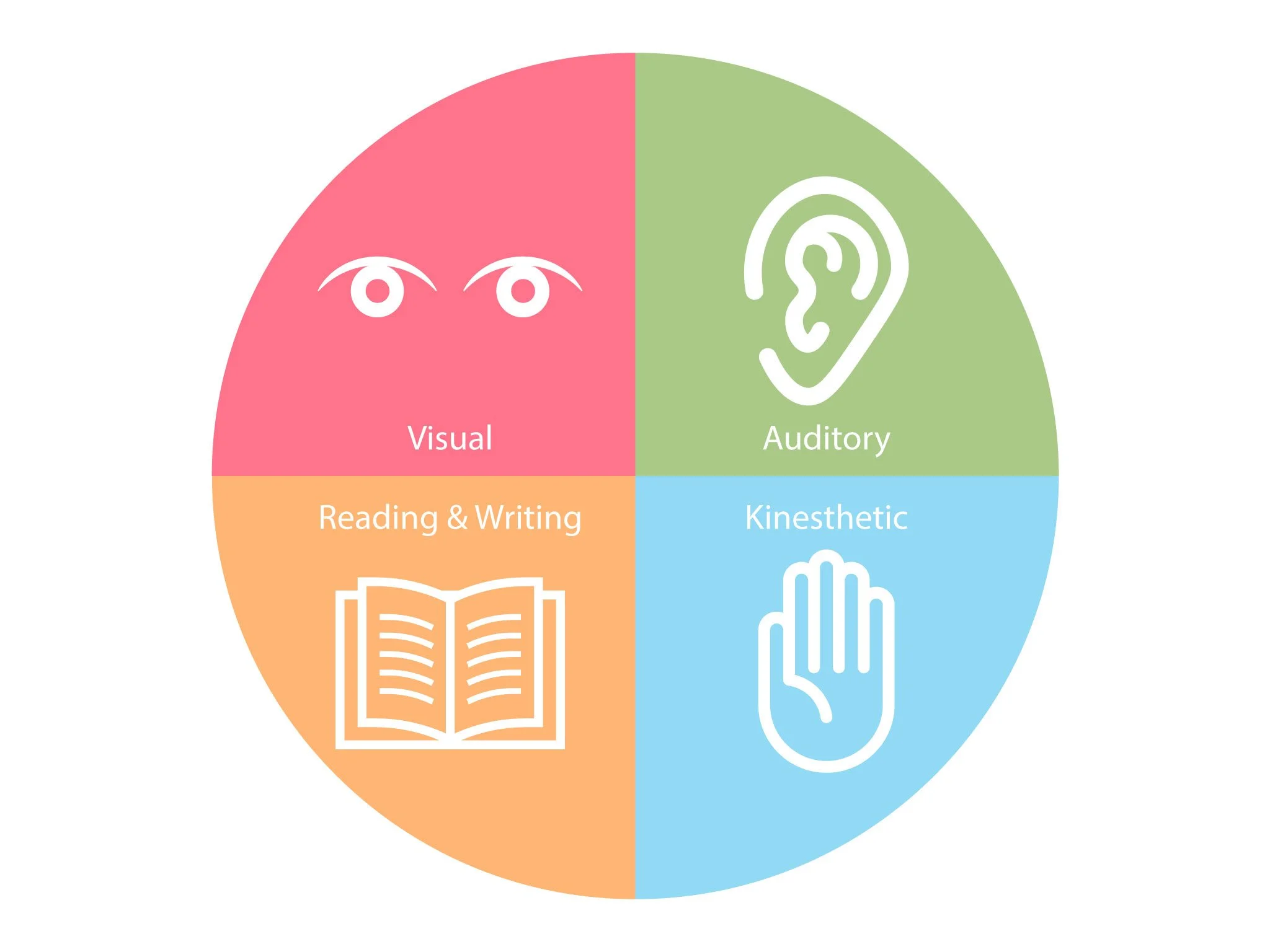
image credit: Preply Images, Creative Commons BY 2.0, via Wikimedia Commons.
I love how discovering your learning style can build confidence and encourage you to try out something new. But quick disclaimer: No need to be a bit too attached to your "type" and start assuming you can't learn certain ways, or that you should avoid input that doesn't match their preference. That's not the point. You can still benefit from listening practice even if you're primarily a visual learner. A lot of people are multimodal, meaning they will work well with a mix of elements.
Let me walk you through each VARK style, with actual practical ideas you can try this week.
🔵 Visual Learners: You Think in Pictures
If you need to see something written down even after someone's explained it, or if you naturally organise things with colours and diagrams, this is probably you.
What to try:
Mind map your vocabulary by theme with drawings and colours
Watch films with subtitles in your target language
Use charts to track verb patterns
Stick illustrated Post-its around your space
🟣 Auditory Learners: You Process Through Sound
You remember song lyrics from years ago. You talk things through out loud to make sense of them. Rhythm and repetition work for you.
What to try:
Listen to podcasts even if you only catch half of it
Read texts aloud to yourself (no one's judging)
Join conversation groups or find a language partner
Make up silly rhymes for grammar rules that won't stick
🟢 Read/Write Learners: You Need to Get It Down on Paper
You like organising, rewriting, making lists.
Take Sarah, one of our AI Language Club members. She'd been learning Spanish for ages but felt stuck until she realised she's a read/write learner. Now she keeps running notes, makes checklists for what she wants to practice, and writes out her own explanations of tricky grammar points.
What to try:
Keep a language journal
Rewrite grammar explanations in your own words
Make glossaries and vocabulary tables
Write summaries of things you've read or watched
🟡 Kinaesthetic Learners: You Learn by Doing
You need to move, touch, make things. Sitting still and "studying" feels impossible.
What to try:
Cook from recipes in your target language
Use gestures when practicing phrases
Try cultural crafts or activities
Give yourself real tasks - write an actual email, order something, follow instructions
Here's What Changes When You Know This
Once you understand how you naturally process information, you can stop fighting yourself.
You stop forcing yourself through methods that were never going to work. You stop comparing your progress to people whose brains operate completely differently. You build learning habits that actually stick because they're designed for you.
And here's the brilliant bit about AI Language Club: we create different types of activities and tools precisely because we know people learn differently. Some members love our image generation games. Others prefer the structured exercises. Some people thrive with our reading materials, others with the audio content.
There isn't one "right" way to learn. There's the way that works for you.
What Now?
If you're stuck at intermediate and suspect your learning approach might be part of the problem, AI Language Club gives you the variety to experiment and find what clicks.
We've got visual materials, audio practice, written exercises, and hands-on activities. Different tools for different brains. And a community of people who get that there's no single path to fluency.